Americans for Earned Wage Access
Responsible Earned Wage Access (EWA) shifts the power of payroll to consumers




Utilized by millions, EWA empowers and protects consumers by creating an important alternative to high-cost loans
EWA enables workers to access wages they’ve already earned before an arbitrary payday to manage short-term financial needs and smooth income distributions. Responsible EWA products are already used by millions of Americans, giving them greater control over their earned income to manage daily and unexpected expenses without creating debt. EWA offers a safe, convenient, and responsible alternative to predatory loans and other high-risk, high-cost products.
Research from the Financial Health Network found that the vast majority of users have a positive experience with EWA and said that continued, responsible use improves their ability to pay bills on time.
An industry advocating for regulation – and clear, consistent consumer protections
A clear, tailored regulatory framework that recognizes the unique structure of EWA will protect consumers through strong safeguards while preserving responsible innovation and consumer choice. EWA providers seek a robust regulatory framework that ensures responsible providers will continue to operate.
EWA is not a loan or credit, and should not be regulated as such. It is non-recourse, with no interest, no late fees, and no credit checks. Attempting to fit EWA oversight into existing regulatory structures or misclassify it as a loan would jeopardize access to a vital and financially empowering tool used by millions of Americans and push consumers—especially income-constrained consumers—toward high-risk alternatives.
Why Americans Need EWA
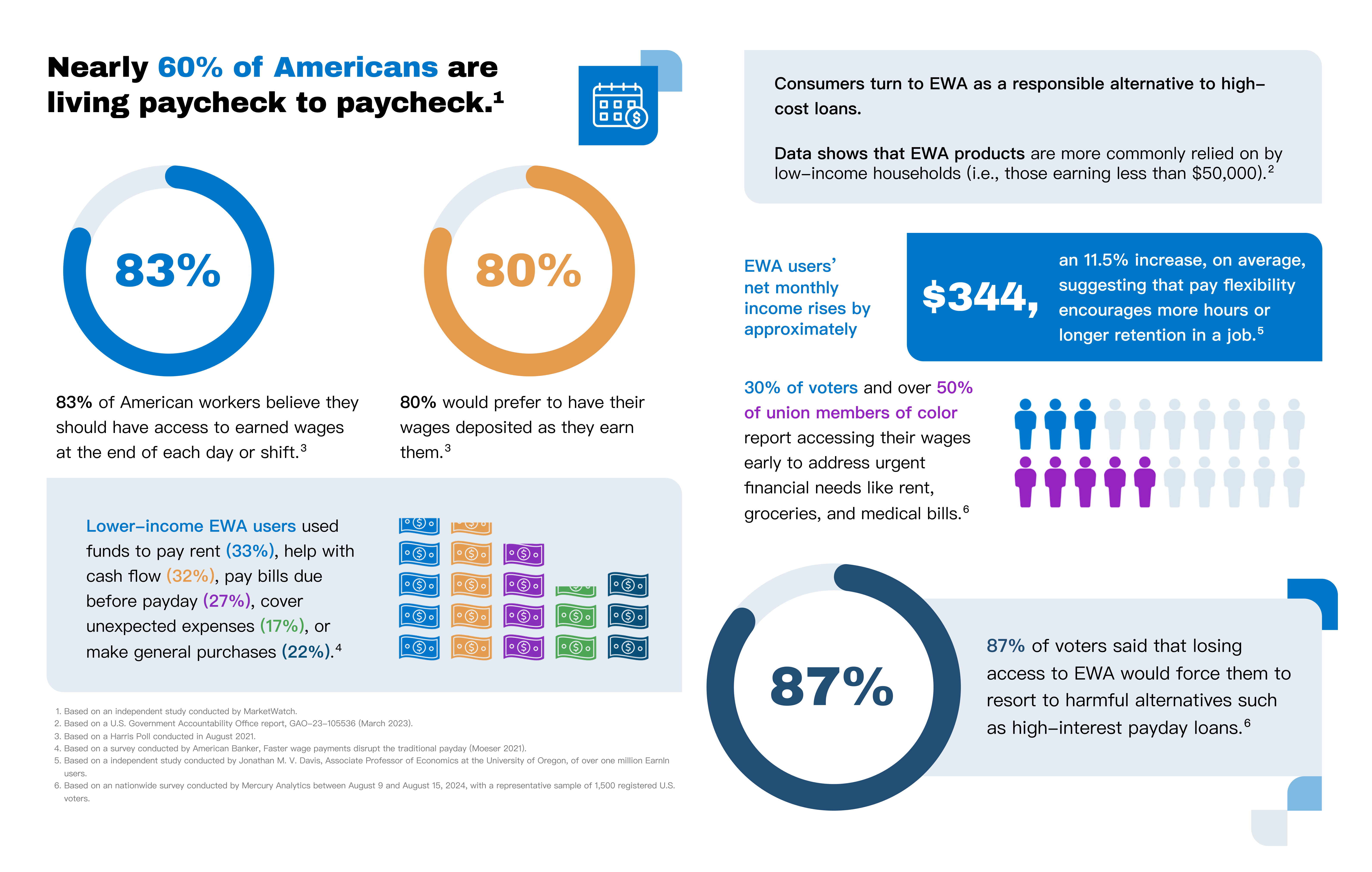
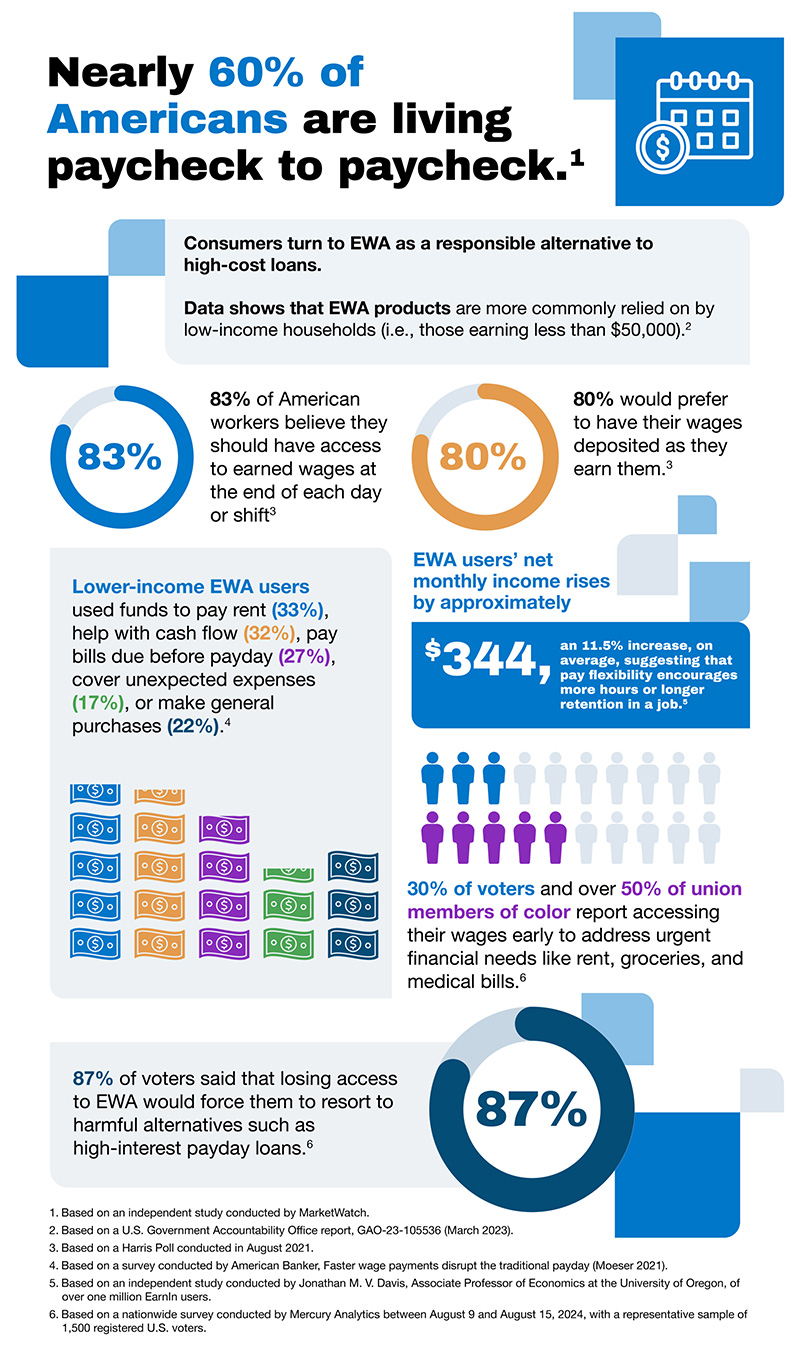
U.S. workers agree: We need EWA


The current state landscape
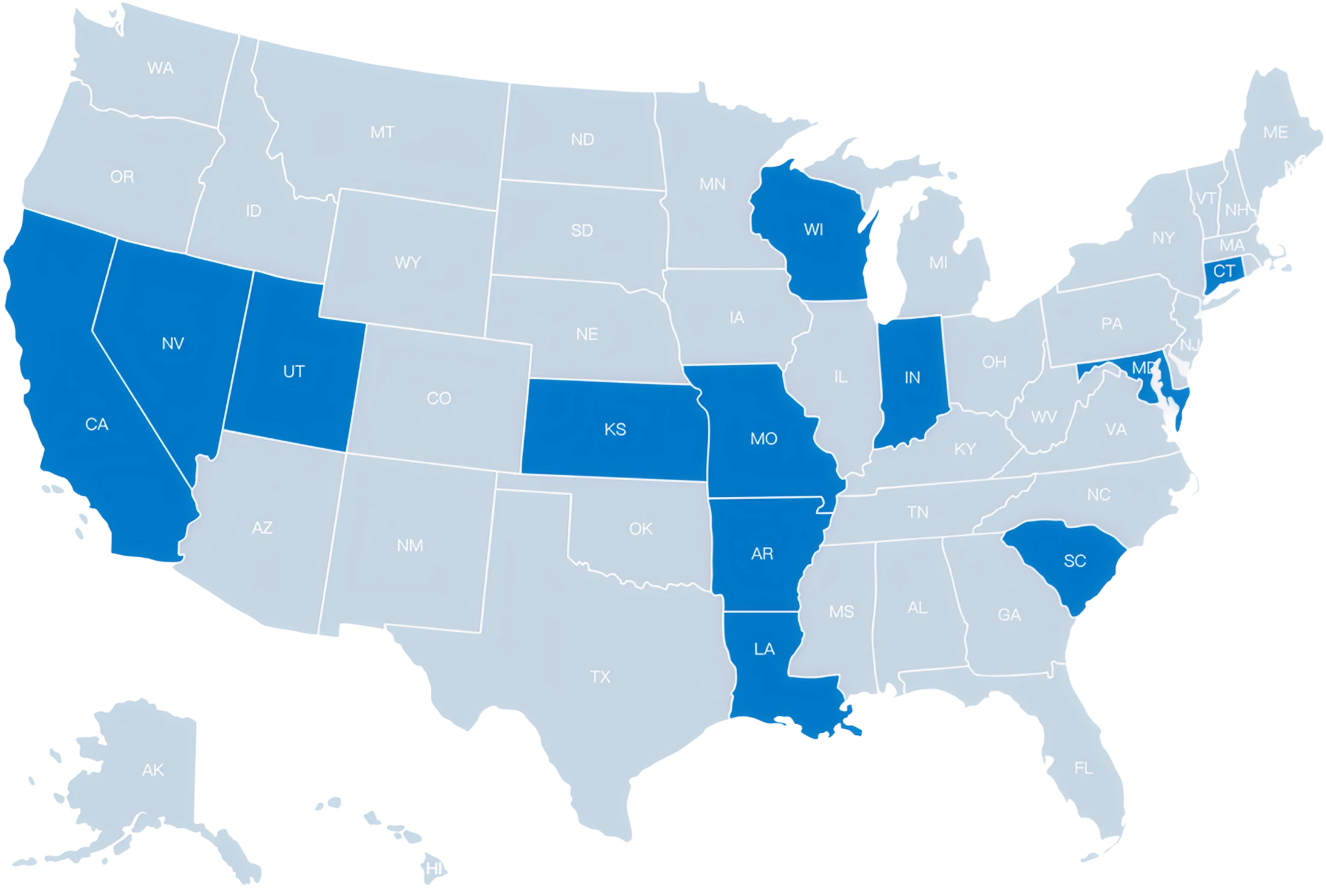
As an emerging financial product, EWA doesn’t fit into traditional lending laws. EWA is properly classified as a unique financial service distinct from loans in 12 states, but state-by-state regulatory frameworks without tailored federal oversight risk creating a patchwork of policies limiting the availability of EWA products based on residence.
The current federal landscape
Rep. Bryan Steil’s has released a bipartisan discussion draft of the Earned Wage Access Consumer Protection Act. This draft legislation represents another important step toward long-overdue regulatory clarity for earned wage access. By establishing a national consumer protection framework and reinforcing that EWA is not a loan, this proposal recognizes the core principles of responsible EWA products and avoids forcing them into outdated lending laws that simply don’t fit.
Establishing a bespoke federal framework through Congressional action that recognizes EWA as a product distinct from loans and credit is critical to preventing misclassification that would eliminate safe options and push consumers toward high-risk alternatives. The CFPB’s new Advisory Opinion accurately defining and explicitly clarifying the core principles of EWA is a constructive first step, and provides the perfect opportunity to codify strong industry rules.
Congress is looking at this issue right now, and American workers need clarity. Federal lawmakers must ensure Americans continue to have access to safe and transparent EWA services.

FAQ
- EWA allows workers to access wages they’ve already earned for work they’ve already completed without creating debt, giving them greater control over their income to manage daily expenses and respond to unexpected financial needs.
- Continued EWA use is proven to increase families’ ability to pay their bills on time. Data also shows that EWA use increases users’ net monthly income by 11.5% on average.
- EWA is an important alternative to high-cost predatory loans. If EWA access is limited, vulnerable populations will have fewer options to access their money safely, conveniently, and cost-effectively.
- In one survey, nearly half (48%) of a group of U.S. workers had no emergency savings, and 80% reported moderate to very high levels of daily financial stress.
- In another survey, 87% of respondents agreed that losing access to EWA would force them to turn to harmful or high-cost alternatives.
- EWA does not create any debt at all, and is designed specifically to avoid cycles of dependency.
- When workers face unexpected expenses between arbitrary pay periods, EWA serves as a safe, convenient alternative to high-cost predatory loans. It is for consumers who do not want debt.
- EWA is limited to wages already earned for work already completed, never based on future earnings. Because EWA has no interest or late fees, costs do not accrue over time, avoiding traditional cycles of debt.
- EWA products are also non-recourse, meaning they do not have to be paid back and are never sent to debt collection for an unpaid balance. This provides users added protection and peace of mind. If a worker has worked three days of a seven day pay cycle and uses an EWA service at that point, they are only entitled to the earnings accrued from the three days worked, nothing more.
- By offering an alternative to high-risk, high-cost products, EWA promotes financial flexibility and short-term stability without exposing consumers to debt cycles or credit penalties.
- EWA is fundamentally different from loan and credit products. It is non-recourse, with no interest, late fees, credit checks, or collections of any kind. Responsible EWA providers offer no-cost options for use.
- EWA is more like an ATM – a source of cash you’ve already earned that’s there when you want or need to access it.
- EWA services offer access to pay workers are entitled to for work already completed, not the promise of future earnings. If a worker quits their job before payday, their employer owes them their pay for the work they completed. EWA operates from a similar principle, providing workers access to pay they are already entitled to by their employer.
- APR is a calculation of interest rates and other costs over time. EWA does not charge interest. Applying APR to a short-term, non-loan, no-interest product like EWA is misleading.
- Applying an APR-like calculation to EWA is more likely to deceive consumers than provide them with an accurate understanding of what EWA is. Simply put, Annual Percentage Rate is an ill-suited metric for products that do not have an annual time horizon.
- The more appropriate approach is clear, transparent disclosure of optional fees that reflects how consumers actually use the product.
- Responsible EWA providers already provide no-cost options.
- EWA use is entirely voluntary, and users see all fees, if any, up-front before confirming a transaction. This is similar to an ATM fee.
- Clear regulatory guardrails and consumer-first design are more effective than applying frameworks intended for traditional lending products.
- Imposing fee caps on consumers may actually limit their ability to gain access to the pay that they are entitled to on their terms.
- Responsible EWA providers already voluntarily adhere to the highest standards and advocate for a clear, consistent regulatory framework reflecting those. These features differentiate EWA from loans and prioritize consumer safety.
- Responsible providers support Congress codifying these standards in federal law, to ensure ALL EWA companies are held to the same high standards of consumer protection.
- Responsible companies agree to the following:
- Unlike loan products, EWA products:
- Do not perform credit checks or inquiries;
- Do not assess fees or base access on creditworthiness;
- Do not charge mandatory fees, interest, or late fees;
- Do not report to credit bureaus; and
- Do not conduct collection activity of any kind on past-due balances.
- Registering and/or obtaining appropriate licenses for employer-integrated or direct-to-consumer product offerings
- Offering a “no cost” option to all users, ensuring there is always an option to access your wages without paying an optional fee
- Committing to data sharing with appropriate state and federal regulatory authorities including describing updated or new features of products and services being offered
- Conducting due diligence on payroll information using reliable data sources
- Guaranteeing the amount of each transaction cannot exceed the employee’s earned wages at the time of the withdrawal
- Displaying strong fee disclosures, represented in a clear and transparent manner, not to be hidden in any way
- If charging tips, displaying strong tip disclosures in close proximity to point of decision, including:
- A tip may be zero;
- A tip is voluntary;
- There is no special treatment for users regardless of who tips and who does not;
- Access to EWA, or frequency of access is not contingent on a tip or its size;
- An explicit ban against misleading or deceiving users about the voluntary nature of tips; and
- A requirement to explicitly state that tips do not benefit any specific, individual person.
- Developing and implementing policies and procedures to respond to inquiries raised by consumers and address complaints from consumers in an expedient manner
- Ensuring the ability for users to cancel their EWA services at any time
- If providers debit bank accounts, reimbursing overdraft fees: EWA providers must take full responsibility and reimburse any overdraft fees they cause by attempting to debit on the wrong date or incorrect amount.
- Unlike loan products, EWA products:
- A University of Oregon study found that 4% of eligible workers use EWA, and those who did earned more and borrowed less.
- Usage data reported by EWA providers shows that the product is most commonly used as a cash flow management tool to help cover expenses between paychecks:
- 75% of users accessed wages through EWA to help cover bills or rent.
- 56% used it for emergency expenses.
- More than a dozen states have already acted to protect this important tool and build in regulatory best practices that ensure consumer protection.
- State legislation and regulation classifying EWA as a product distinct from loans and credit ensures the availability of safe, convenient alternatives to predatory loans and other high-risk, high-cost products.
- In contrast, fitting EWA into existing frameworks that do not recognize the nuances of the product would limit access to a tool many consumers rely on for financial stability.


.png)


%20(1).png)


.png)
.png)



%20Logo_Color_png.png)


.avif)

.png)


.webp)